Types of Assessment in eLearning: What Your LMS Records
اقرأ بالعربية →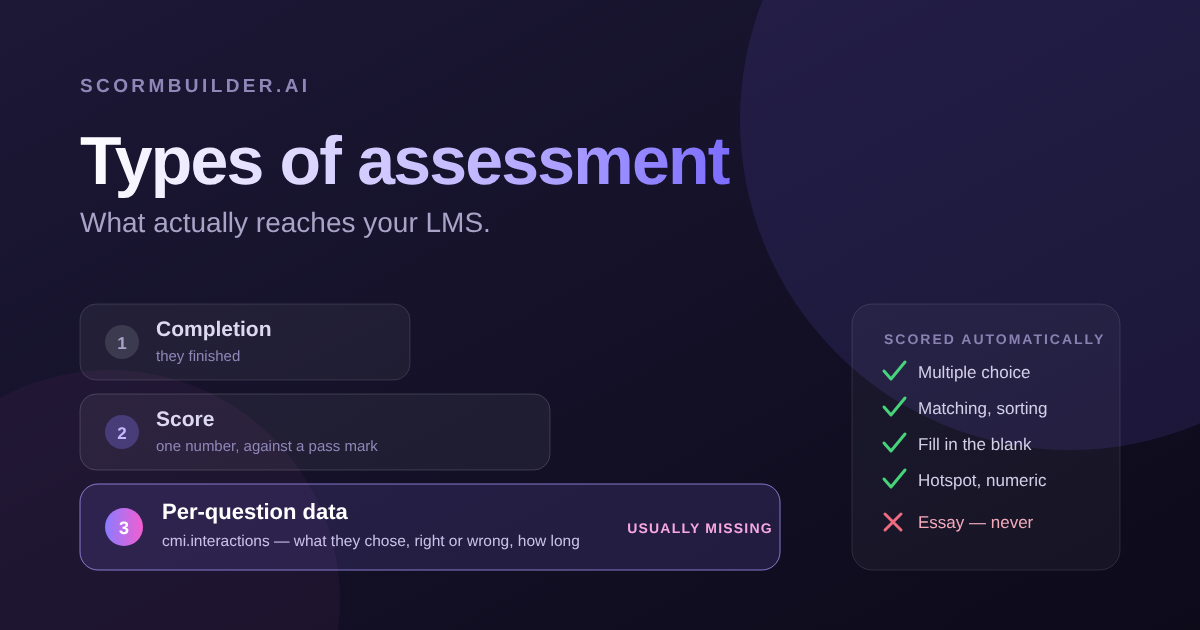
Most guides to assessment types are written for classrooms. They explain diagnostic, formative and summative, give examples from a reading group, and stop. If you build workplace training that publishes into an LMS, that leaves out the part that decides what you can actually choose: what survives the journey from your course to your LMS report.
You can design a beautiful assessment and still end up with one number in a row. Which type of assessment you can use depends on what your LMS will record, and that depends on the question types you pick and the standard you export.
The four types worth knowing in workplace learning
Diagnostic assessment runs before the learning. It finds out what people already know, so you can let experienced staff skip ahead and spend the time where it is needed. In an LMS this usually lives as a short pre-test, and the useful output is a decision rather than a grade.
Formative assessment runs during the course. Its job is to make the learning stick — a question after a concept, a scenario mid-module, a flip card that forces a guess before showing the answer. It is low stakes and usually not recorded, and that is the point. The moment you record it, learners start optimising for the score instead of using it to check themselves.
Summative assessment runs at the end and produces the record. This is the one your organisation cares about, the one with a pass mark, and the one you will be asked to produce if the training is ever questioned.
Observational assessment happens away from the LMS entirely. Someone watches a person do the task and judges whether they can do it. No quiz replaces this for a practical competency, and the honest approach is to use the course for the knowledge and record the observation separately.
Formal or informal cuts across all four. Formal means it counts, it is recorded, and the conditions are consistent. Informal means it is a check for understanding. In workplace training the distinction is mostly about evidence: formal assessment has to be defensible months later, informal does not.
What your LMS actually records
Here is the part the classroom guides skip. Whatever you build, what reaches your LMS falls into three levels.
Level one: completion. Someone finished. SCORM 1.2 reports this through lesson_status; SCORM 2004 splits it into completion_status and success_status, so a person can complete a course and fail it — two facts instead of one. Every LMS handles this level.
Level two: a score. One number, usually out of 100, against a pass mark. Both SCORM versions carry it. This is where most authoring tools stop.
Level three: per-question data. Which question, what the learner chose, whether it was right, how long they took. Both SCORM 1.2 and SCORM 2004 define this through cmi.interactions, and xAPI carries it as statements to a learning record store.
Level three is where the useful information lives — the question 70% of people get wrong is usually telling you something about the course rather than the learners — and it is the level most often missing. Two things have to be true for it to work. Your authoring tool has to write the interactions, which many do not bother to do. And your LMS has to store and expose them, which varies enormously. One quirk worth knowing: in SCORM 1.2 the interaction fields are write-only by specification. The course can send them and can never read them back, so if your LMS does not surface them, the data is gone as far as anyone can tell.
Question types, and what each one reports
| Question type | SCORM interaction type | Scored automatically | Good for |
|---|---|---|---|
| Multiple choice | choice | Yes | Knowledge recall, fast to write |
| True or false | true-false | Yes | Quick checks; weak as summative, 50% is luck |
| Multi-select | choice | Yes | ”Select all that apply” — harder than it looks to mark fairly |
| Matching | matching | Yes | Terms to definitions, tools to tasks |
| Sorting and sequencing | sequencing | Yes | Procedures and order of operations |
| Fill in the blank | fill-in | Yes, if you anticipate the wordings | Terminology, exact values |
| Numeric entry | numeric | Yes | Calculations, tolerances, dosages |
| Hotspot and labelling | other | Yes | Equipment, diagrams, spotting a hazard |
| Drag into categories | matching or other | Yes | Classification and judgement calls |
| Branching scenario | other, or xAPI | Partly — the path is the result | Decision-making under pressure |
| Open text and essay | — | No | Reasoning you have to read; marked by a person, outside the package |
The last row is the one that catches people. SCORM has no mechanism for marking free text. If your assessment depends on an essay, the mark happens somewhere else and your LMS record will not contain it unless you put it there by hand.
Which standard carries which evidence
| You need | Minimum standard |
|---|---|
| Who finished | SCORM 1.2 |
| Who passed, and their score | SCORM 1.2 |
| Completion and pass recorded as separate facts | SCORM 2004 |
| Per-question data in the LMS | SCORM 1.2 or 2004 — if your LMS stores interactions |
| Question-level analytics you can query | xAPI or cmi5 |
| Assessment that happens outside the LMS | xAPI |
| A long assessment that must resume mid-way | SCORM 2004 — 1.2 caps resume data at 4,096 characters |
If you are choosing between these, SCORM vs xAPI goes into the trade-off properly.
Choosing, for workplace training
Start from the evidence you owe. If someone may have to prove in three years that a named person passed this, you need a summative assessment with a recorded score, and that constrains everything else.
Match the assessment to the competency, not to the convenience. Multiple choice is easy to build and easy to mark, which is exactly why it gets used for things it cannot test. If the competency is a judgement call, a branching scenario assesses it far better than four options ever will.
Set the pass mark against the number of questions. 70% of three questions is two out of three — 67% — which fails. Check the arithmetic, not the convention.
Decide who marks what before you build. An assessment that needs human marking is a workload you are creating for someone. If nobody has agreed to do it, the assessment will quietly stop being marked.
Keep formative assessment unscored. As soon as a practice question counts, it stops being practice.
The trap: assessments that teach but cannot evidence
The most common failure is not a bad question. It is a course full of excellent formative activity — scenarios, drag-and-drop, practice questions — followed by a summative quiz that reports a single number, when the organisation’s actual need was proof that this person can recognise a specific hazard.
Work backwards instead. Write down the sentence you would need to be able to say in an audit. Then check that the data behind it reaches your LMS, in a field somebody can report on. Everything else in the course can be as rich as you like.
Where SCORMBuilder.ai fits
For transparency on the level-three point above: SCORMBuilder.ai writes cmi.interactions for both SCORM 1.2 and SCORM 2004, and emits the equivalent answered statements for xAPI — per question, with the id, the type, the learner’s response, whether it was correct and how long they took. The interaction types it reports are choice, true-false, fill-in, matching, sequencing, numeric and other.
That is worth checking in any tool you evaluate, including ours, because it is invisible until the day you need the data and discover it was never sent. What we cannot do is change whether your LMS stores it — that one is between you and your administrator.
Before you publish any of it, the SCORM course launch checklist covers the export settings that decide whether the score arrives at all.
Frequently Asked Questions
What are the main types of assessment in eLearning?
Four matter in workplace training. Diagnostic assessment runs before the course to find out what people already know. Formative assessment runs during it to help learning stick, and is usually not scored. Summative assessment runs at the end and is the one that produces the record. Observational assessment happens away from the LMS, where a person watches someone do the task.
What is the difference between formative and summative assessment?
Formative assessment is for the learner: low stakes, frequent, used to correct understanding while the course is still running, and usually not recorded. Summative assessment is for the organisation: it happens at the end, it produces a score and a pass or fail, and it is the thing you will be asked to produce if the training is ever questioned.
Does SCORM record individual quiz answers?
It can. Both SCORM 1.2 and SCORM 2004 define cmi.interactions, which carry each question's id, type, the learner's response and whether it was correct. Two things have to be true: the authoring tool must actually write them, which many do not, and your LMS must store and expose them, which varies widely. In SCORM 1.2 the interaction fields are write-only by specification, so the course cannot read back what it sent.
Which question types can be scored automatically?
Anything with a defined correct answer: multiple choice, true or false, multi-select, matching, sorting and sequencing, fill in the blank, numeric entry, hotspot and drag-into-category questions. Open text and essay answers cannot be scored automatically by SCORM — they need a person to mark them, which means the mark happens outside the package.
Do I need SCORM 2004 or xAPI for assessment reporting?
Not for a score and a pass or fail — SCORM 1.2 carries both. You need SCORM 2004 if you want completion and success recorded as separate facts, or more room for resume data on a long assessment. You need xAPI or cmi5 if the assessment happens outside the LMS, or if you want question-level analytics you can query rather than read case by case.
How do you assess skills that a quiz cannot test?
Use the course to assess the knowledge and a branching scenario to assess the judgement, then assess the physical skill through observation and record the outcome separately. The mistake is forcing a practical competency into multiple choice so that it produces a tidy number — you end up with evidence that someone can recognise the right answer, not that they can do the job.